


The model known as the conscious competence model, formulated by Broadwell (1969) and popularised by Burch (Gordon Training International), used by many authors and well known in NLP, describes the 4 stages of learning or of developing a skill as follows:
1️⃣ Unconscious incompetence: we do not know that we are incompetent, or why
For the actor, this is for instance the stage where, when he steps on stage, he is in a state of panic called stage fright:
😳 he is paralysed, he feels watched by his audience and by his partner (if the latter pays him any attention, which is not a given)
🤐 and he is unable to say what he feels, what he thinks, what he wants to do, and to access organic, intuitive, free behaviours or reactions
🤷♂️ he thinks this is normal, and that there is no other possible way of doing things on stage
🗣 he will try to learn other skills to mask, numb or divert the problem while avoiding dealing with it (diction, declamation, or the use of alcohol, drugs, or heavy relaxation and emotional preparation beforehand).
2️⃣ Conscious incompetence: we become aware of the problem and its mechanisms
For the actor, this is the moment when he starts wanting to deal with and take into account what happens on stage while he is on stage.
The repetition exercise gives, from the outset, a framework to:
🔥 express and share what is happening to us and desensitise ourselves to this paralysing context while accepting and transmuting this stress, this energy, this excitement...
🏋️♂️ train ourselves to keep our attention on the other and on ourselves while maintaining this contact link and letting it evolve
💬 tell the truth, become aware of our impulses, points of view, emotions, and let them show (or, failing that, verbalise them) as they emerge, without judging them...
💡 It is also the moment when we can become aware that there are grey areas in what Gestalt calls the contact cycle: among others, defence mechanisms and inhibitions in interacting with other people (and in particular while being watched)
3️⃣ Conscious competence: we become consciously competent
For the actor, this is the training where all these buried things begin to be accepted, released, expressed...
⚠️ gradually and without forcing, and not once and for all like an exorcism such as one witnesses in some acting classes or some therapy practices, which are impressive to watch and to go through but often create additional resistances and inhibitions in the medium to long term
💡 It is about unfolding, as they say again in Gestalt, reassuring and suggesting, as they say in Ericksonian hypnosis, and modelling, as they say in NLP, the structure of our subjective experience to align it little by little with the work, through training and systematic / progressive desensitisation following approaches from cognitive behavioural therapy, for example:
👉 by settling into this technique within the framework of a class
👉 as well as autonomously, outside, in another place but with the same classmates
👉 then by working with people from other groups
👉 then with a text and after having explored the progressive foundations of subtext
👉 then in other places and while being filmed
👉 then with other people who do not practise the same technique and in professional working conditions...
4️⃣ Unconscious competence: we no longer need to think about what we are doing to be competent
For the actor, this is when everything becomes automatic.
😌 we know intuitively how we feel at every moment as soon as we ask ourselves the question
⚡️ we can quickly identify what a context makes us feel - the "energy" of people or places from our point of view
📝 we know how to identify, when reading a text, what it is essentially about
💭 and ideas come to us naturally from simple imaginary circumstances which, if they were true, would take us from our present state (or here, behaviour) to the desired state (or here, behaviour)
🏋️♂️ and we have practised enough, by ritualising the work, for these back-and-forths to be ecological, that is to say healthy, for ourselves
📚 (according to the PS-DS-ECO model in NLP: Present S**tate, **Desired S**tate, **ECOlogy of change)
🤓 All these references are there out of curiosity for those who are interested, and also to understand the point and purpose of the work and the training, since according to the principles of andragogy (adult learning), understanding the purpose of the work (or its point, its meaning) is one of the main motivating factors for working over the long term.
👉 To conclude, a Meisner quote which is displayed as a motto on our website:
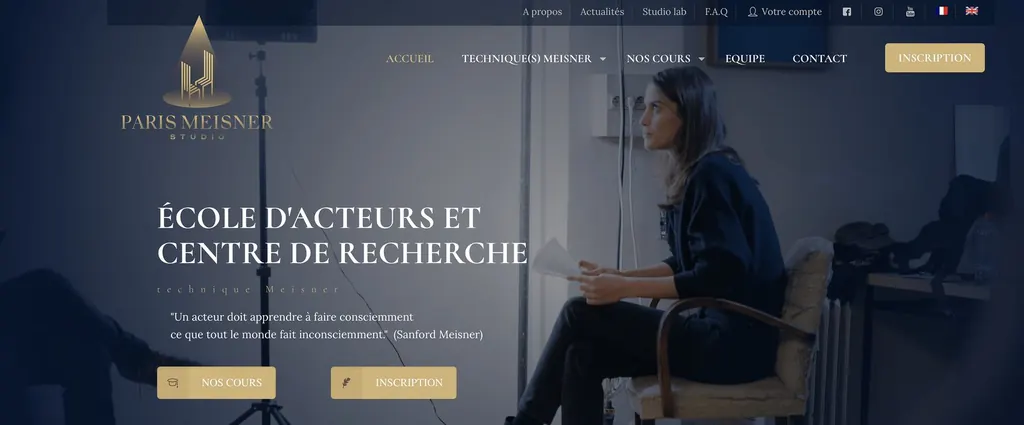
"An actor has to learn to do consciously what everyone does unconsciously."
💡 We could update this quote by saying: "An actor has to learn to do unconsciously (or subconsciously) what everyone does unconsciously."