

This text was sent to the members of our Online Studio Lab among the pedagogical resources that accompany the live sessions.
To go directly to your favorite section, you can scroll down the table of contents at the top of the page.
🧠 Among all the steps involved in working on a scene, the memorisation of the text is often the most tedious, and the least fun.
🤡 And yet it is essential, because the actor who forgets their lines falls into the cliché of the “bad actor” who could not even learn their cues, and ends up paralysed.
💡 As always, we will explore here the playful and effective ways to master this necessary skill, avoiding the classic pitfalls…
…of a superficial memorisation that does not hold up “in play”, …of a memorisation that is too rigid and sounds “recited”, …or of visualisation techniques that are counterproductive, dissociating the actor and preventing them from being natural.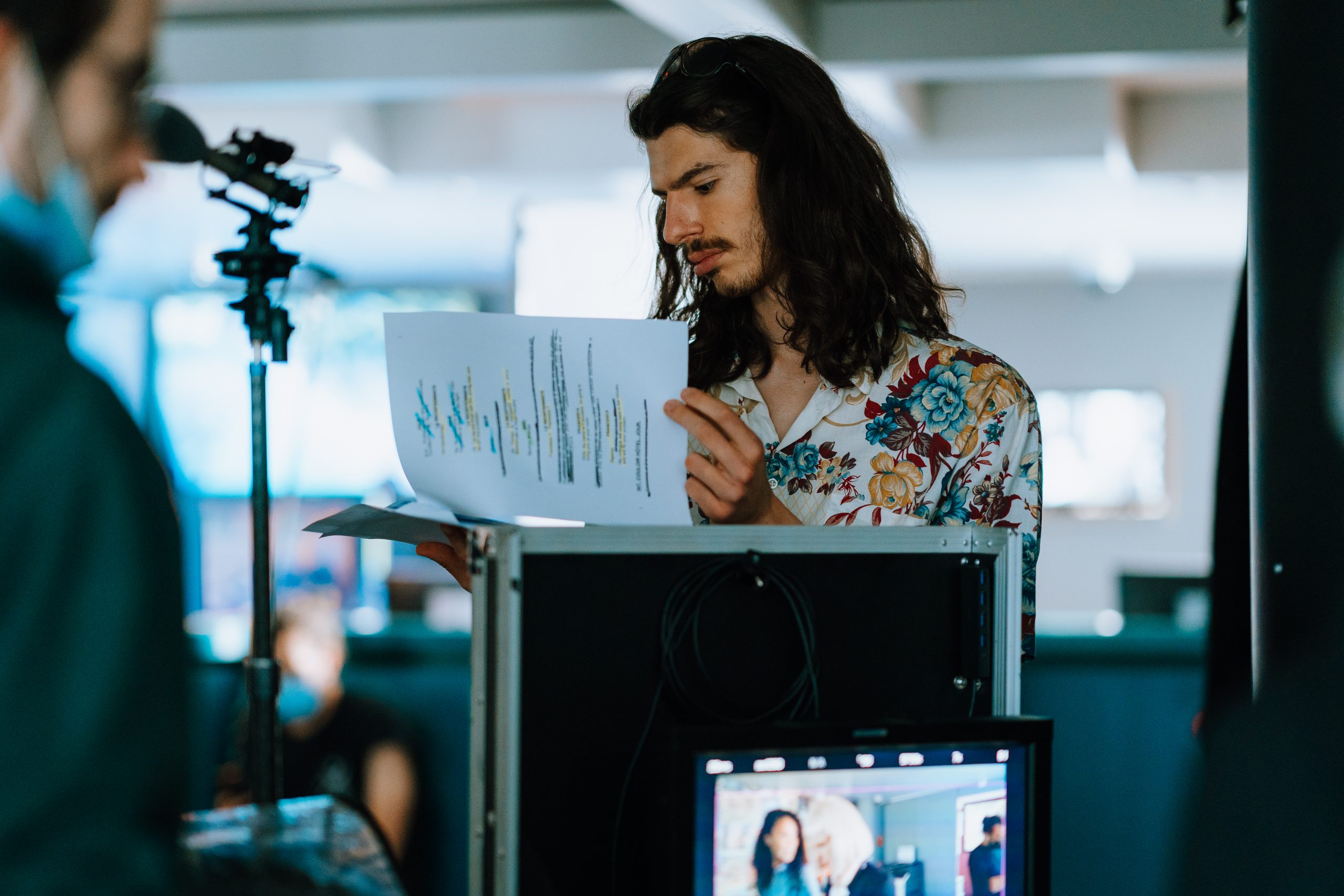

⚠️ The problem with the usual memorisation techniques taught in acting classes
🤔 There are many popular memorisation “tricks” for actors, or just in general, such as…
👉 repeating or rewriting the same lines endlessly in order, hoping they will eventually “sink in”
👉 making a film of the scene in your head as seen from the outside (imagining the emotions, the intonations, the “situation” to prepare how to play it, while also retaining it in a more immersive way)
👉 building a “memory palace” in your mind, a visual space where words or lines would live, sometimes with the (bad) idea of placing emotions, intonations, and ways of playing there at the same time
👉 techniques supposedly “drawn from neuroscience” that suggest taking a long relaxation period before learning, then moving your body during it, doing physical activities at the same time, like running or cooking… to activate certain areas of the brain, which some studies have shown… and because some famous actors do it…
👉 recording yourself to listen back (because some of us are more “auditory” than others…)
… and many other variations or combinations of these techniques.
💡 There are two possible problems with all of this:
❌ either it does not really work, and it is very heavy going
❌ or it works a little and is slightly more fun (the “visualisation techniques” type) but in a way that necessarily creates an imaginary intermediary (what you picture visually) in order to access the information.
💭 As you can see when practising the repetition exercise, imagining something that does not exist, that is to say thinking about something else, dissociates us (from what is happening in front of us, from what we are doing, etc).
⛰ Except in rare cases where the entire text could be particularised by a psychological activity in which the character is precisely thinking about something else, learning your lines with these intermediary tricks will create a gap between you and the text that will never truly disappear.
🙁 And therefore limit all of our subtext options and acting direction choices.
😃 The solution is therefore to learn the text in a way that is admittedly mechanical, but effective and fun, with no playing intention and no imaginary intermediaries.
💒 Our miracle technique for learning your lines quickly, and without visualisation
👉 For this, there is a memorisation technique derived in part from educational science and the concept of active recall, based on the following principles:
1️⃣ Like a muscle, our memory retains information well when we make an active effort to retrieve it (provided we do actually end up retrieving it). Repeating, recopying, re-listening, rereading, highlighting… is more or less useless.Testing yourself on the information to retrieve is genuinely effective, as long as the effort is neither too easy nor completely impossible.
2️⃣ Second principle: Reading a word does not require complete and coherent information about the letters that make it up.
Rdanieg A Wrod Deos Not Rquerie Cmolpete And Cehreont Ifnromtaion Aobut The Ltteers Taht Mkae It Up. R_ A W_ D_ N_ R__ C__ A_ C__ I__ A__ T_ L_ T__ M_ I_ U_
R A W D N R C A C I A T L T M I U
Having just read the previous sentence, you should be able to retrieve it fairly easily with just the first letter of each word. Or at least a large proportion of it.
Immediate memory (or relatively immediate for a longer text) and context (the meaning of the sentence) should be sufficient stepping stones to retrieve the complete sentence: Reading a word does not require complete and coherent information about the letters that make it up.
This partial effort to retrieve a sentence you have just read from the first letters of its words is an excellent middle ground for making the memorisation exercise both achievable and effective.
🤓 Try again:
R A W D N R C A C I A T L T M I U
😯😃🥳
Brilliant!
💡 The idea behind our memorisation technique is as follows:
- read the text in full, understanding its meaning (even if you do not have your partner’s lines for this exercise, understand what you are saying)
- write on a sheet of paper the first letter of each word, for each of your lines and without punctuation (though keeping apostrophes, hyphens and accents if you like)
- test yourself using this written aid on the full text (or on sections of equal length, if it is too long to do in one go)
- check against the original text, going back and forth after first making a genuine effort to retrieve the missing information (but without spending more than 5 or 10 seconds trying to find a missing piece either)
There are other complementary memorisation strategies we can discuss together, but this step is the first, and the main one.
Can’t wait to hear how it went for you,
see you next week (with the text learnt)!
Octave

💡 It is never too late to go over your lines, with Zakari Bankov.
📍 On the set of our first short film “C’est pas le Pérou”, directed by Octave Karalievitch & Guillaume Caramelle, and written by Aurélien Laplace.
📸 Ema Martins


